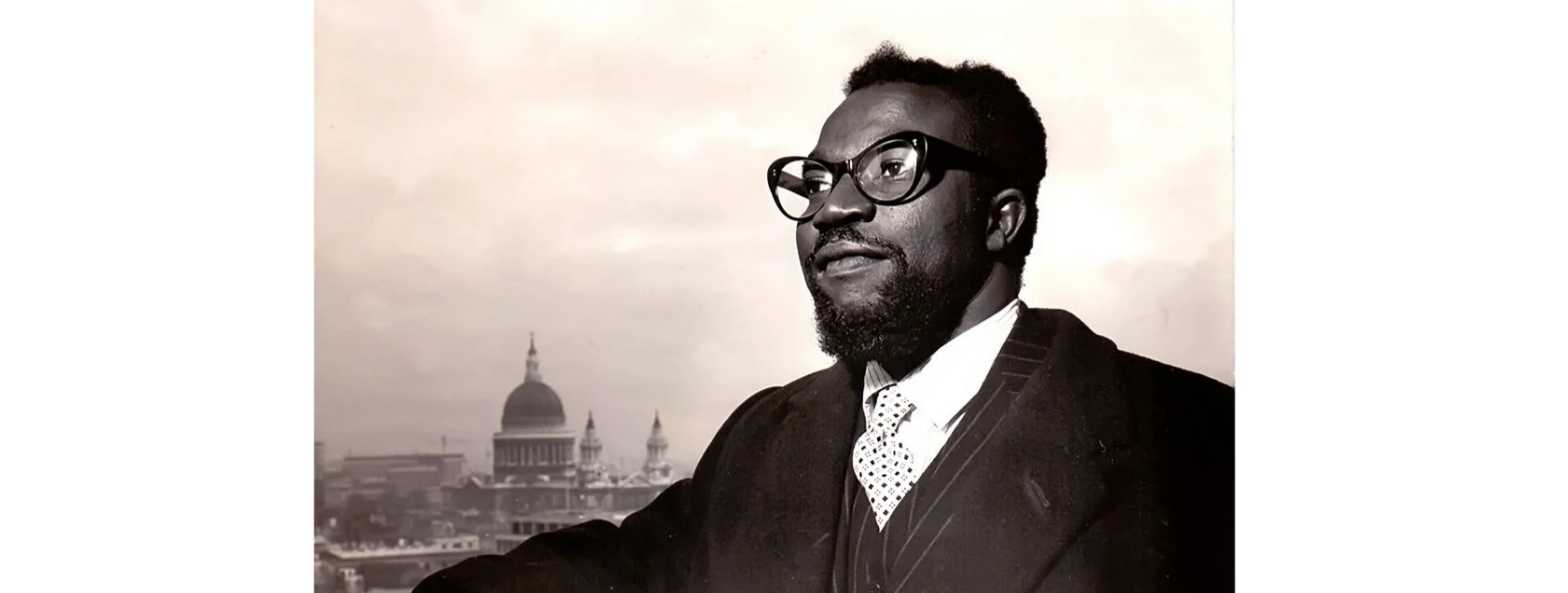
Even Mercury Remembers Him: The Nigerian Artist With a Crater Named After Him in Space
Every July 14th, art lovers, historians, and proud Igbo sons and daughters pause to remember one of Africa's greatest cultural icons: Benedict Chukwukadibia Enwonwu, born in 1917 in Onitsha, Anambra State. Known simply as Ben Enwonwu, he grew up to become one of the most influential modernist artists of the 20th century — and, as it turns out, his legacy didn't stop on Earth.
There's a crater on the planet Mercury named after him.
Who Was Ben Enwonwu?
Ben Enwonwu was born into a family already steeped in artistic tradition. His father was a respected Igbo sculptor who created religious carvings, stools, and staffs of office for the Onitsha community, while his mother ran a successful textile business. From childhood, Enwonwu inherited both his father's tools and his talent, laying the foundation for a career that would eventually place him among the most celebrated artists Africa has ever produced.
He studied art in Nigeria before earning a scholarship to study in England, attending institutions including Goldsmiths, the Ruskin School of Drawing at Oxford, and the Slade School of Fine Art in London — where he became the first African graduate.
By 1950, international media had already crowned him "Africa's Greatest Artist."
His accomplishments over a six-decade career include:
Becoming the first African artist commissioned by Queen Elizabeth II, sculpting her bronze portrait in 1956.
Creating Anyanwu, his most iconic bronze sculpture, representing the Igbo earth goddess Ani — a full-size cast of which now stands at the United Nations Headquarters in New York.
Serving as Nigeria's first professor of Fine Arts, at the University of Ife.
Painting Tutu, a portrait later dubbed "Africa's Mona Lisa," which sold for over £1.2 million at auction decades after going missing.
Being honored with an MBE and Nigeria's National Order of Merit for his contributions to art and culture.
Enwonwu passed away on February 5, 1994, in Lagos — but as the world would later discover, his story was far from over.
The Surprising Discovery: A Crater on Mercury Bears His Name
In a fascinating twist that most people — even lifelong fans of his work — don't know, NASA's MESSENGER spacecraft captured images of a crater on Mercury that would go on to be officially named "Enwonwu" in his honor.
Here's what makes this discovery so remarkable:
The image was captured on January 14, 2008, using the Narrow Angle Camera (NAC) of the Mercury Dual Imaging System (MDIS), while the spacecraft was flying at an altitude of roughly 23,000 kilometers (14,300 miles) above Mercury's surface.
Enwonwu crater measures 38 kilometers (24 miles) in diameter.
The crater features a central peak and a striking set of bright rays radiating outward from its rim — rays that stretch across the surrounding terrain and even cross neighboring craters.
According to planetary scientists, these bright rays are a key indicator of the crater's relative age. On Mercury, ray systems fade and darken over time due to space weathering, so a crater with rays this vivid is considered geologically young compared to the planet's older, worn surface features. In other words, Enwonwu crater isn't just named after him — it's still visibly "glowing," much like the legacy it honors.
From Onitsha to Outer Space
It's rare for an artist's name to transcend the canvas, the gallery, or even the country of their birth. Ben Enwonwu's name now exists in three places that tell a story of pure Igbo excellence:
Onitsha, Nigeria — where it all began.
The United Nations Headquarters, New York — where his sculpture Anyanwu stands as a symbol of postcolonial African identity.
The surface of Mercury — where a crater with his name catches sunlight 77 million kilometers from home.
Why This Story Matters
Ben Enwonwu's life is a powerful reminder that excellence has no ceiling — not culture, not geography, not even planetary boundaries. He took traditional Igbo artistry and fused it with modern techniques to create a visual language that reshaped how the world saw African art. Decades after his passing, his influence keeps resurfacing — in record-breaking auction sales, in prestigious exhibitions like the Tate Modern's Nigerian Modernism showcase, and now, quite literally, in the night sky.
So today, as we celebrate what would have been his birthday, it feels fitting to say it plainly: even Mercury remembers him.
Happy heavenly birthday, Ogbuefi. Ndi Igbo kwenu.
Sources: NASA/MESSENGER Mission (MDIS imagery), Wikipedia, Sotheby's, Ben Uri Research Unit, Google Arts & Culture.